


How Long Does an Office Fit Out Take in Dubai?
An office fit out in Dubai rarely fails because of one big delay. It usually slips because several smaller items stack up: late drawings, missing landlord approvals, long-lead materials, Civil Defence comments, building access restrictions, or changes after work has already started.
Quick answer:
A typical office fit out in Dubai takes around 6 to 16 weeks once the design is agreed, depending on the size of the office, condition of the space, landlord approvals, authority submissions, MEP works, material availability and furniture lead times. A simple refresh may take 2 to 6 weeks, while larger or shell and core offices can take 16 to 28+ weeks.
For most businesses, the fastest projects are simple refreshes in already fitted offices. The longest projects usually involve full mechanical, electrical, plumbing, fire safety, authority approvals, joinery, flooring, ceilings, glass partitions, IT rooms, AV systems and furniture installation.
In This Guide
How long does an office fit out take in Dubai?
Timeline by project type
Shell and core vs CAT A vs existing fitted offices
Main stages of an office fit out
Dubai office fit out approvals and timeline factors
Common causes of delay
How to keep your project on schedule
Example office fit out programme
How OFD helps businesses plan fit out timelines
Most Office Fit Outs Take 6 To 16 Weeks
A small office refresh can take around 2 to 6 weeks if it only includes painting, carpets, minor partition changes, light fixture swaps, signage and loose furniture.
A standard office fit out, where the contractor builds partitions, ceilings, flooring, joinery, electrical points, data cabling, pantry areas, meeting rooms and finishes, often takes 8 to 14 weeks.
A larger fit out can take 14 to 24 weeks or more, especially when it includes high-end materials, imported furniture, acoustic rooms, executive areas, server rooms, specialist lighting, major MEP changes or phased handover requirements.
A rough guide looks like this:
Type of project | Typical duration | What usually affects the timing |
Light refresh | 2 to 6 weeks | Paint, flooring, minor repairs, furniture delivery |
Small fitted office | 4 to 8 weeks | Simple partitions, services, finishes, approvals |
Standard CAT B fit out | 8 to 14 weeks | Layout changes, MEP, fire safety, joinery, IT |
Large or premium fit out | 14 to 24+ weeks | Custom materials, complex approvals, phased handover |
Shell and core office | 16 to 28+ weeks | Full services, ceilings, floors, washrooms, authority scope |
These ranges are not guarantees. They are planning ranges. A well-managed 300 m² fitted unit may finish faster than a poorly planned 120 m² space, because clarity matters more than size alone.
The type of space makes the biggest difference
Not all offices start from the same point. In Dubai, the condition of the unit at handover has a major effect on the schedule.
A shell and core space takes the longest
A shell and core unit is usually an empty space with basic structural elements. It may have limited services available, but it still needs a full internal build.
That can include:
Raised flooring or floor finishes
Suspended ceilings
HVAC distribution
Lighting and power
Fire alarm and fire fighting works
Data cabling and IT rooms
Pantry and wet areas
Glass partitions and doors
Custom joinery
Final finishes and furniture
This type of project often needs deeper design work and more coordination with authorities, the landlord, and building management.
A CAT A space is quicker, but still needs planning
A CAT A office usually has base finishes and core building services in place. It may already include ceilings, lighting, air conditioning, raised floors, and basic fire systems.
The fit out then focuses on making the space usable for a specific company. That normally means meeting rooms, cabins, open work areas, pantry spaces, storage, reception areas, IT, furniture, branding elements, and final finishes.
Because the base services already exist, a CAT A to CAT B fit out can move faster than a shell and core project.
An existing fitted office can be the fastest option
If the current layout is close to what is needed, the project may only require a refresh. That can include new paint, flooring, furniture, lighting upgrades, and minor repairs.
The hidden risk is what sits behind the finishes. Old wiring, damaged AC ducts, weak partitioning, or non-compliant fire safety items can turn a “quick refresh” into a more serious job.
A proper site survey before pricing helps reduce that risk.
The main stages of an office fit out in Dubai
A good programme separates the project into stages. Some stages overlap, but each one needs clear sign-off before the next can move properly.
Site survey and brief
This stage can take a few days to 1 week for a straightforward space.
The team checks the actual condition of the unit, takes measurements, reviews the landlord guidelines, and confirms what the business needs from the space.
This is where the most useful questions get answered:
How many people will use the office?
How many enclosed rooms are needed?
Is there a server room or IT rack?
Will the pantry need water and drainage?
Are there acoustic needs?
Does the lease require handover by a fixed date?
Are there building work-hour restrictions?
A weak brief causes repeated redesigns. A clear brief can save weeks.
Concept design and space planning
This often takes 1 to 3 weeks, depending on how quickly decisions are made.
The designer prepares the layout, broad finishes, room sizes, furniture plan, and circulation. In Dubai, this stage should also consider landlord rules, local authority requirements, and building services.
Changes are cheaper here than on site. Moving a meeting room on a drawing is simple. Moving glass partitions, ceiling works, electrical points, and AC diffusers after installation is expensive and slow.
Detailed design and technical drawings
This can take 1 to 3 weeks for a standard project, and longer for complex spaces.
Technical drawings cover the details contractors and approval bodies need. They may include:
Partition layout
Reflected ceiling plan
Lighting layout
Power and data layout
HVAC changes
Fire alarm and fire fighting drawings
Flooring plan
Joinery details
Door schedule
Finishes schedule
The more complete the drawings, the fewer arguments and surprises during construction.
Approvals and permits
Approvals can take 1 to 4 weeks or more, depending on the building, location, and project scope.
In Dubai, approvals may involve the landlord, building management, free zone authority, Dubai Municipality, Dubai Civil Defence, DEWA, telecom providers, or other relevant bodies. Some areas and business districts have their own processes, and some buildings insist on approved contractor lists.
This is one of the most common causes of delay. The fit out cannot always start, or cannot start fully, until the right approvals and no-objection certificates are in place.
Procurement and material ordering
Procurement may run alongside approvals, but it still needs careful timing.
Readily available materials in the UAE can arrive quickly. Custom joinery, imported finishes, specialist lighting, carpet tiles, acoustic panels, and branded furniture can take longer.
For a standard fit out, allow 2 to 6 weeks for key procurement. For imported or bespoke items, allow more.
A smart project team identifies long-lead items early. Waiting until site work starts to choose flooring or furniture is a common mistake.
Site works and installation
The build stage is what most people think of as the fit out. For a standard office, it often takes 4 to 10 weeks.
The work may include demolition, partitions, MEP, ceilings, flooring, joinery, glass, painting, fixtures, final electrical works, IT cabling, testing, cleaning, and furniture placement.
The order matters. If ceiling work starts before services are coordinated, the team may need to open it again. If flooring is installed too early, it may get damaged by later trades.
Testing, snagging, and handover
Handover usually takes 1 to 2 weeks, though larger offices may need longer.
This stage includes testing systems, checking fire safety items, correcting defects, cleaning, collecting warranties, gathering as-built drawings, and preparing handover documents.
Snagging should not be treated as a minor task. A space can look finished but still have issues with doors, access control, AC balancing, sockets, lighting controls, drainage, or paintwork.
Why MEP Coordination Matters
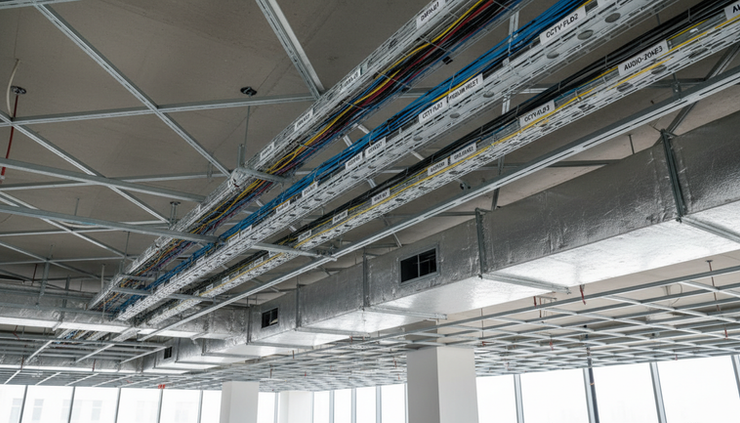
MEP coordination often decides whether the programme stays on track.
Lighting, power, AC, data, fire alarm, fire fighting and ceiling works all need to be planned together before construction begins. If these systems are not coordinated early, problems usually appear on site, where they cost more time and money to fix.
For example, a meeting room may look correct on the layout, but it still needs AC supply and return, fire safety coverage, lighting controls, power, data, AV cabling and acoustic consideration. If one of those items is missed, the programme can quickly slip.
Why Material Selection Should Happen Early
Material readiness can save days during the build stage.
Flooring, lighting, furniture, joinery finishes, acoustic panels, glass specifications, worktops, door hardware and imported items should be selected before site works begin wherever possible.
Early selections help the contractor confirm availability, place orders, coordinate delivery dates and avoid last-minute substitutions. They also reduce the chance of delays caused by unavailable materials or late client decisions.
Dubai Office Fit Out Approvals And Timeline Factors
Dubai has a mature commercial property market, but every tower, free zone, landlord and district may work a little differently. The contractor has to plan around those differences.
In Dubai, the approval route can vary depending on whether the office is located in a mainland tower, free zone, master developer community or managed commercial building. Before confirming a fit out programme, businesses should check which submissions are required for landlord approval, building management NOC, Dubai Civil Defence, Dubai Municipality, DEWA, telecom providers or free zone authorities.
Landlord rules can add time
Many office buildings issue fit-out manuals. These can cover working hours, service lift booking, waste removal, noise limits, insurance, contractor registration, fire stopping, protection of common areas, and inspection procedures.
If a contractor ignores these rules, site access can be stopped. Even a one-day access issue can affect several trades.
Authority approvals vary by location
A fit out in a mainland commercial tower may follow a different approval route from a project in a free zone. A unit in a district governed by a specific master developer may also need extra submissions.
The safest approach is to confirm the approval pathway before finalising the programme.
Building access can slow deliveries
Dubai towers often have strict access procedures. Large deliveries may need advance booking, security clearance, service lift slots, loading bay access, and after-hours work.
This matters for glass panels, joinery, furniture, flooring, and heavy equipment. A missed delivery slot can push installation by several days.
Ramadan, public holidays, and summer planning matter
Work can continue through much of the year, but schedules should allow for shorter working patterns during Ramadan, public holidays, and summer heat when labour-heavy tasks and logistics can be harder to manage.
This does not mean projects must stop. It means the programme should be realistic.
What usually causes delays
Most fit-out delays are avoidable. They often come from decisions and coordination, not the physical work itself.
Common causes include:
Late approval of layouts and finishes
Unclear project scope
Missing landlord or authority documents
Changes after construction begins
Long-lead imported materials
Weak coordination between MEP and interior works
Delayed furniture selection
Access restrictions in the building
Late payment approvals or procurement holds
Snagging left too late
The biggest risk is changing the brief after site work starts. A new room, a shifted door, or a different ceiling finish can affect drawings, approvals, materials, labour, and inspections.
Even small changes can disturb the sequence.
How to keep an office fit out on schedule
A fast project is not rushed. It is clear.
The best way to protect the timeline is to make decisions early, document them properly, and give the contractor enough information to plan labour and materials.
Freeze the layout before approvals
Once technical submissions begin, avoid changing the layout unless there is a strong reason. Any change to partitions, occupancy, fire routes, MEP, or room use may affect approvals.
Choose materials before site work starts
Finishes should be selected before procurement begins. This includes flooring, paint colours, ceiling types, lighting, door hardware, glass, worktops, pantry finishes, and furniture.
A finish schedule is simple, but it saves time.
Confirm who approves what
Every project needs a clear decision path. If three people need to approve every drawing, make that known early. If the landlord must review samples, add that to the programme.
Slow approvals can damage a schedule as much as slow construction.
Build in time for inspections
Do not plan the move-in date on the same day site works end. Allow time for inspections, authority comments, defect corrections, cleaning, IT testing, and furniture adjustments.
A 1-week buffer can make the difference between a calm handover and a stressful move.
Use a realistic programme, not the shortest one
A contractor may promise a very short timeline to win the work. That can be risky if it ignores approvals, procurement, delivery slots, or snagging.
A reliable programme should show:
Design time
Approval time
Procurement dates
Site phases
Inspection points
Client decision deadlines
Handover and snagging period
If those items are missing, the timeline is probably too optimistic.

A realistic timeline example
A typical 500 m² Dubai office moving from CAT A to a finished CAT B workplace might follow this kind of schedule:
Stage | Estimated time |
Site survey and brief | 3 to 5 days |
Concept design and layout | 1 to 2 weeks |
Detailed drawings | 2 to 3 weeks |
Landlord and authority approvals | 2 to 4 weeks |
Procurement | 2 to 6 weeks, partly overlapping |
Site works | 6 to 10 weeks |
Testing, snagging, and handover | 1 to 2 weeks |
If managed well, some stages overlap. For example, procurement can start for approved items while final approvals continue. Still, overlap must be handled carefully. Ordering materials before approvals can create waste if drawings change.
For planning purposes, many businesses should allow 10 to 16 weeks from confirmed brief to move-in for a standard project. More complex spaces should allow longer.
How OFD Helps Businesses Plan Office Fit Out Timelines
At OFD, we help businesses plan realistic office fit out programmes before work starts on site.
Our team reviews the condition of the space, landlord requirements, authority approvals, design scope, MEP needs, procurement risks, IT and AV requirements, furniture lead times and move-in deadlines to create a clear project roadmap.
This helps clients understand what can be delivered, where delays may occur and how to protect the timeline from design stage through to handover.
For companies relocating or reviewing a new office, early timeline planning can also support better lease decisions, budget control and move-in planning.
If you are still comparing buildings or lease options, our Workspace Advisory service can help assess the office before you commit. For a full workplace transformation, explore our Office Fit Out service. If your project requires meeting room technology, boardroom systems or structured cabling, our Office IT & AV team can help coordinate those requirements during the planning stage.
The takeaway
So, how long does an office fit out take in Dubai? A simple refresh may take a few weeks. A standard commercial fit out often takes 8 to 14 weeks. A larger or more complex project can run for several months.
The timeline depends on the starting condition of the space, the approval route, the amount of MEP work, material availability, landlord rules, and how quickly decisions are made.
The best projects start with a clear brief, complete drawings, early authority checks, and realistic procurement planning. Get those right, and the fit out has a much better chance of finishing on time, within scope, and ready for a smooth move-in.
Frequently Asked Questions
How Long Does A Standard Office Fit Out Take In Dubai?
A standard office fit out in Dubai usually takes around 8 to 14 weeks, depending on the size of the office, design complexity, approvals, MEP works, procurement and furniture delivery.
Can An Office Fit Out Be Completed In Less Than One Month?
Yes, but usually only for light refresh projects or small fitted offices where the existing layout and services are mostly retained. Larger layout changes, authority approvals, joinery, MEP works and furniture delivery usually require more time.
What Causes The Most Delays In Dubai Office Fit Outs?
The most common delays come from late design decisions, incomplete drawings, landlord approvals, authority comments, long-lead materials, building access restrictions, MEP coordination issues and client changes during construction.
Do Office Fit Outs In Dubai Require Approvals?
Most commercial office fit outs in Dubai require some form of landlord, building management, free zone or authority approval. The exact route depends on the building location, project scope and whether fire safety, MEP or structural elements are affected.
When Should We Start Planning An Office Fit Out?
Businesses should ideally start planning before signing a lease or immediately after selecting a preferred office. Early planning helps identify fit out costs, approval requirements, timeline risks and whether the space is suitable for the company’s needs.
Does Furniture Affect The Office Fit Out Timeline?
Yes. Workstations, task chairs, meeting tables, loose furniture, custom joinery and imported items can all affect the project timeline. Selecting furniture early helps avoid delays near handover.
Comments